
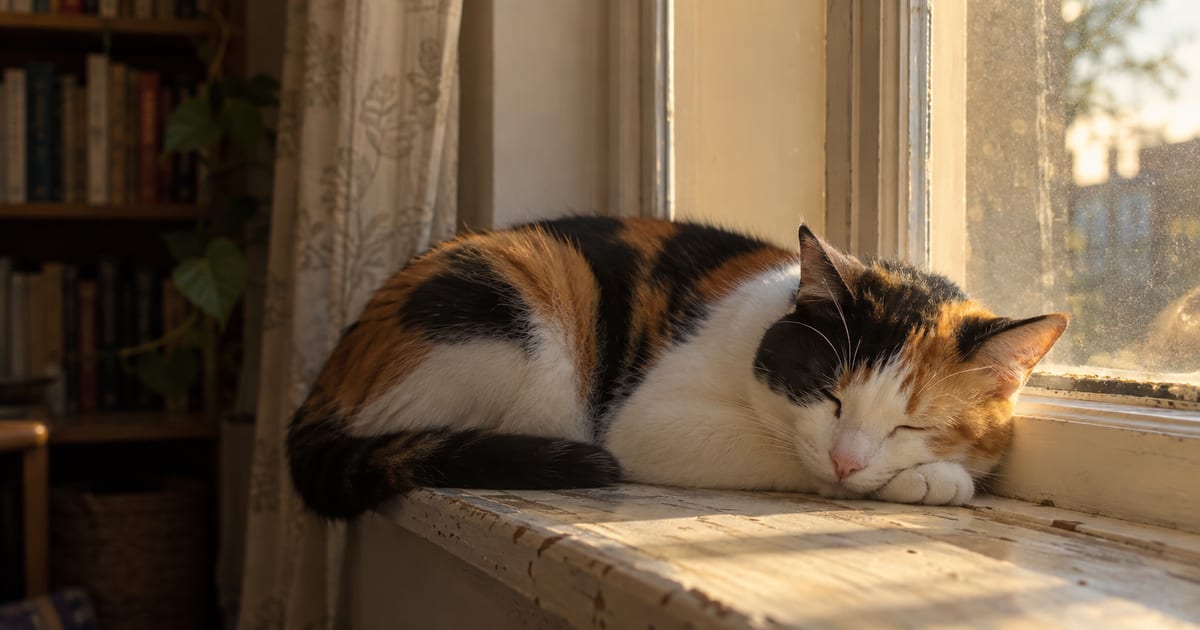
Almost always, but not quite. The gene that makes orange fur sits on the X chromosome, so a cat needs two X chromosomes to wear orange and black in the same coat. Cats with two X chromosomes are female. A male calico happens only when his cells carry an unusual chromosome arrangement, and the surveys below show how uncommon that is.
That is the short answer, and it holds up. The longer answer is more interesting, because the patches on a calico are a visible record of a decision every one of her cells made before she was born.
Why does color depend on the X chromosome?
Start with how the chromosomes arrive. The MSD Veterinary Manual lays it out plainly: female cats receive an X chromosome from both the mother and the father, while male cats get a Y chromosome from the father and an X chromosome from the mother. That single sentence does most of the work in this subject.
Now add the color. Orange is carried on the X chromosome itself. A calico or tortoiseshell cat, MSD explains, receives one X chromosome with the black coat color gene and one X chromosome with the orange coat color gene. Because two X chromosomes are required for the calico and tortoiseshell coats, almost all cats showing these colorings are female.
For a long time the gene behind the orange was known to be on the X without anyone knowing which gene it was. That changed in 2025, when Kaelin and colleagues published the molecular answer in Current Biology: the mutation responsible for orange sits at the Arhgap36 locus, and it produces orange coat color in hemizygous males, which is to say males carrying it on their single X, and in homozygous females carrying it on both.
A male cat has one X, so he gets one answer to the question. Orange, or not orange. He has no second X to disagree with the first, and that is the whole reason a tri-color tomcat is a curiosity rather than a common sight.
What does X-inactivation actually do?
A female cat with one orange X and one non-orange X has a problem to solve: two copies of a chromosome where one will do. Mammals solve it by switching one X off in each cell, early in development, at random.
Kaelin and colleagues describe the result exactly. Random X-inactivation in female embryos that carry the Arhgap36 deletion on one X underlies both the tortoiseshell and the calico color patterns. The orange patches are clones in which the non-orange allele was inactivated. The black or brown patches are clones in which the orange allele was inactivated. Each patch of red, yellow, black or brown hair is the clonal expansion of a single developing pigment cell.
So the map on a calico’s coat is not decoration. It is a record of which cells silenced which chromosome, blown up to the size of a cat. No two calicos carry the same map, and littermates do not match, which is why the pattern is genuinely one of a kind rather than merely described that way.
What makes a calico different from a tortoiseshell?
White, and white has nothing to do with the X chromosome at all.
A tortoiseshell cat is orange and black marbled together. A calico is the same orange and black arrangement with white added, and the patches look bigger and more clearly separated. Kaelin’s paper gives the mechanism: in calico cats the color patches are expanded relative to the tortoiseshell cat, caused by an autosomal dominant white spotting mutation at the Kit locus. The difference between the two coats is that extra white spotting mutation, which reduces the ability of developing pigment cells to survive. Fewer pigment cells spreading through the skin means blank white ground between the colored areas, and colored areas with cleaner edges.
Autosomal means it is not on a sex chromosome, so white spotting arrives independently of everything above. If you want the two coats side by side with the features a photo can actually show, that is the calico versus tortoiseshell comparison, and each has its own reference page: calico cat and tortoiseshell cat.
How rare is a male calico?
Rarer than an ordinary cat, and less rare than the number you have probably read.
The figure worth quoting comes from a survey published in the Veterinary Record in 1999. Leaman, Rowland and Long sent a questionnaire about coat color and sex to 2,585 veterinary practices in the United Kingdom and gathered information on 9,816 cats. Of 4,598 males in that sample, 20 were recorded as tortoiseshell, which is 0.43 percent. From the same data the authors calculated the frequency of the orange gene in that population at 19.7 percent.
Note what that number is and is not. It counts tortoiseshell males, not calico males specifically, and it is one national sample from one year. It is still the most useful published figure available, and it is considerably more common than the one in 3,000 that circulates on pet sites, which we could not trace to any registry, veterinary reference or paper. When a figure has no source behind it, the honest move is to leave it out.
Are male calico cats always sterile?
Mostly, but the reason is more specific than the headline.
The MSD Veterinary Manual describes the rare male calico or tortoiseshell as a cat born with two X chromosomes, only one of which becomes active, plus a Y chromosome, and states that this XXY arrangement also causes sterility. A 2026 review of tortoiseshell tomcats in Sexual Development gives the mechanism: XXY syndrome leads to sterility because spermatogenesis does not occur in the affected testes.
The complication is that XXY is not the only route to a tri-color tom. In the British survey, 11 male tortoiseshell cats were examined cytogenetically, and the results split several ways: six had a 38,XX/38,XY complement, two were 39,XXY, two were 38,XX and one was 38,XY. XXY was the minority finding. The 2026 review reaches the same conclusion from the other direction, reporting that most XX/XY males were either fertile or had testes with reduced sperm production, and stating plainly that tortoiseshell coat color in a male cat is not necessarily associated with sterility.
So the accurate version is this: a male calico is unusual, the XXY ones are sterile according to both sources above, and not every male calico is XXY. Anything beyond that about a particular cat is a question for that cat’s veterinarian, not for an article or a photograph.
Is calico a breed?
No. Calico is a color, and colors are not breeds. The Cat Fanciers’ Association breed list runs from Abyssinian through to the rest of its recognized breeds without calico, tortoiseshell, tabby or tuxedo appearing anywhere on it, because those words describe how a cat is painted rather than what it is.
That means a calico cat is whatever breed or mix it would have been in any other color. The coat tells you about one gene on one chromosome and nothing at all about ancestry. Several recognized breeds accept the pattern, and a great many calicos are the ordinary domestic cats covered on the domestic shorthair page, which is the honest answer for most cats anywhere.
What a photo can tell you about your calico
It can tell you what she is wearing. Coat length, the balance of white, the shape of the patches, build, head shape, ear set and tail: all of that is visible, and all of it is what breed identification actually works from. It cannot tell you which X was silenced in which cell, and it cannot tell you her karyotype.
If you want the resemblance sorted for you, Cat Identifier reads one photo and returns the breeds the cat most resembles as a percentage mix, with the traits, typical temperament and history behind each one. It is a statement about visible likeness, not about lineage, and only registration papers from a registry establish pedigree. For the whole sorting method, worked by hand, see what breed is my cat.
Sources
- Calico and Black and Orange Tortoiseshell Cats, MSD Veterinary Manual
- Kaelin et al., Molecular and genetic characterization of sex-linked orange coat color in the domestic cat, Current Biology 35(12), 2025
- Leaman, Rowland and Long, Male tortoiseshell cats in the United Kingdom, Veterinary Record 144(1), 1999
- Szczerbal et al., XX/XY Chimerism in Tortoiseshell Tomcats: A New Case and Review of the Literature, Sexual Development, 2026
- Breeds, The Cat Fanciers' Association