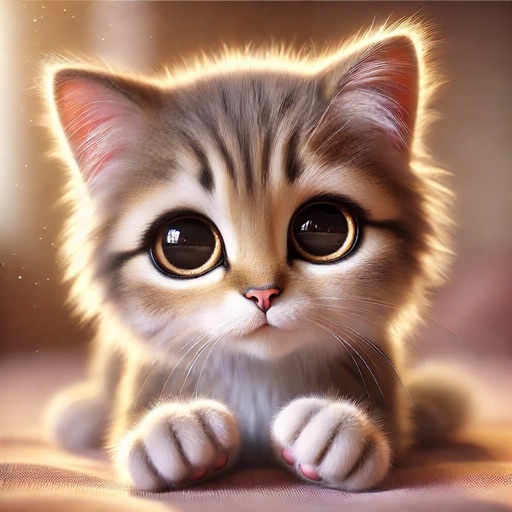
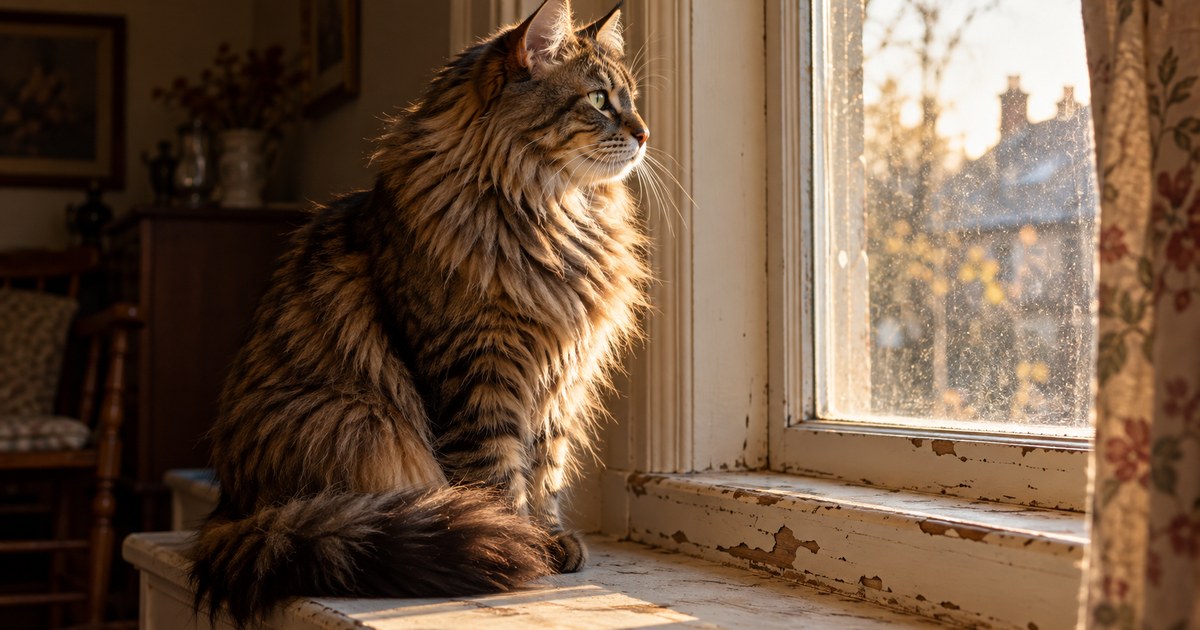
Look at the muzzle in profile. The Cat Fanciers’ Association requires a Maine Coon’s to be “visibly square, medium in length and blunt ended.” It requires a Siberian’s head to be a “modified wedge” with “rounded contours” that “narrows slightly to a full-rounded muzzle.” Square and blunt, or narrowing and round. That one view separates them.
Everything else on the two cats overlaps: both are big, both are long-coated, both have a ruff, both have tufted feet, and both take years to finish growing. Start at the head and the rest falls into place. Ragdolls and RagaMuffins are another pair people mix up, and Ragdoll vs RagaMuffin separates those two.
Why does the head separate them and the size does not?
Because the standards put the weight of the description there.
Straight on, the Maine Coon head is “medium in width and slightly longer in length than width with a squareness to the muzzle.” The Siberian head is a modified wedge with rounded contours. There are no sharp planes on a correct Siberian and no soft ones on a correct Maine Coon. The Siberian standard makes the point from the other direction too: it penalizes a “straight profile” and a “narrow or fox-like muzzle,” so even the ways a Siberian is allowed to be wrong are different from what a Maine Coon is required to be.
Size does not separate them, and it is worth saying why people think it does. CFA gives the Siberian a published weight range of 12 to 18 pounds for males and 8 to 12 for females. It gives the Maine Coon no numeric range at all in the standard text, noting only that males commonly reach or exceed 20 pounds. So the ranges overlap almost completely, and in a house with one cat there is nothing to compare against anyway.
Weight is also an unreliable signal in general. Campigotto and colleagues, working from the veterinary records of 19,015,888 cats in the Journal of the American Veterinary Medical Association in 2019, found that mean body weight for the most common recognized breeds peaked between six and ten years of age and then declined. A cat’s number on the scale reports its age at least as much as its ancestry. The large cat breeds comparison goes through that in more detail.
What does the coat tell you?
More than size, less than the head, and it is the second thing to check.
The Siberian’s coat is described by CFA as a triple coat, moderately long to longhaired, with an “abundant full collar ruff” and hair that may “thicken to curls on the belly and britches.” The texture “varies from coarse to soft” over a “tight undercoat.” That tight undercoat is the feel people describe as dense and springy.
The Maine Coon’s coat is described very differently: “heavy and shaggy; shorter on the shoulders and longer on the stomach and britches,” with a texture that is “silky with coat falling smoothly.” The defining quality is unevenness. A correct Maine Coon coat looks like it was cut by weather rather than groomed, short over the shoulders and long everywhere the cat sits.
In a photograph, look at the shoulder line. If the coat drops away short over the shoulders and lengthens dramatically down the flank and britches, that is the Maine Coon description. If the coat is of a fairly even moderate length all over with a big collar ruff standing out at the front, that is closer to the Siberian.
What about the ears, eyes and tail?
These are the confirming checks once the head has pointed somewhere.
Ears. The Maine Coon’s are “large, well-tufted, wide at base, tapering to appear pointed,” set “approximately one ear’s width apart at the base; not flared.” The Siberian’s are “medium-large, rounded, wide at the base and tilt slightly forward,” set “as much on the sides of the head as on top,” with ear tipping allowed. Pointed and upright versus rounded and tilted forward.
Eyes. The Maine Coon standard asks for “large, expressive, wide set with an opened oval shape,” slightly oblique with a slant toward the outer base of the ear. The Siberian’s are “medium to large, almost round,” with the outer corner angled slightly toward the base of the ear. Oval and slanted versus almost round. The Siberian standard explicitly penalizes almond-shaped eyes, which tells you how much the roundness matters.
Tail. The Maine Coon’s is “long, wide at base, and tapering,” with fur “long and flowing.” The Siberian’s is “medium in length, somewhat shorter than the length of the body,” wide at the base and “tapering slightly to a blunt tip.” A tail that reaches the shoulder blade when laid along the back is reading Maine Coon. A noticeably shorter, blunter tail is reading Siberian.
Body. The Maine Coon wants that “well-balanced rectangular appearance.” The Siberian wants a torso “medium in length, and well muscled with the back arched slightly higher than the shoulders, with a barrel-shaped, firm belly.” A long rectangle versus a barrel with a slight rise over the hips.
Is there a third cat in this comparison?
Usually, yes. The Norwegian Forest Cat sits between them and is mistaken for both. CFA describes its head as an “equilateral triangle, where all sides are of equal length as measured from the outside of the base of the ear to the point of the chin,” with a profile “straight from the brow ridge to the tip of the nose without a break in the line,” and a “distinguishing double coat” of dense undercoat under water-resistant guard hairs.
Its disqualification list is the most useful paragraph in this whole comparison, because it names a square muzzle and a long rectangular body as faults. Those are precisely the two things the Maine Coon standard requires. Three breeds, three head geometries: rectangle, triangle, rounded wedge. The Maine Coon versus Norwegian Forest Cat page covers that pair on its own.
The honest ending
A cat can carry a square muzzle and a barrel body, or rounded contours and a shaggy uneven coat, and there is no contradiction in that, because a mixed cat inherits features rather than a package. Lipinski and colleagues, sampling over 1,100 cats from twenty-two breeds for Genomics in 2008, found that the foundation breeds were genetically distinguishable from one another with 95 percent accuracy and that four breed pairs could not be separated at all. Breeds are populations with edges, not categories with walls.
Which is why the most likely answer to “Maine Coon or Siberian” is neither. A large, long-coated, ruffed cat with no papers is most often an unregistered domestic longhair, which the domestic shorthair page covers, and the features that make it beautiful come from the same ancestry both breeds were built from. Only registration papers naming a cat’s parents establish pedigree.
Take two photographs in daylight, one straight on so the head reads as a rectangle or a rounded wedge, and one in profile so the muzzle shape and nose line show. Cat Identifier reads those proportions and returns the breeds your cat most resembles as a percentage mix, with the traits behind each match. It reports visible likeness, not ancestry. If you want to work the Maine Coon side by hand, is my cat a Maine Coon takes the standard trait by trait.
Sources
- Maine Coon Cat breed profile and show standard, The Cat Fanciers' Association
- Siberian breed profile and show standard, The Cat Fanciers' Association
- Norwegian Forest Cat breed profile and show standard, The Cat Fanciers' Association
- Lipinski et al., The ascent of cat breeds: genetic evaluations of breeds and worldwide random bred populations, Genomics 91(1), 2008
- Campigotto et al., Investigation of relationships between body weight and age among domestic cats stratified by breed and sex, JAVMA 255(2), 2019