
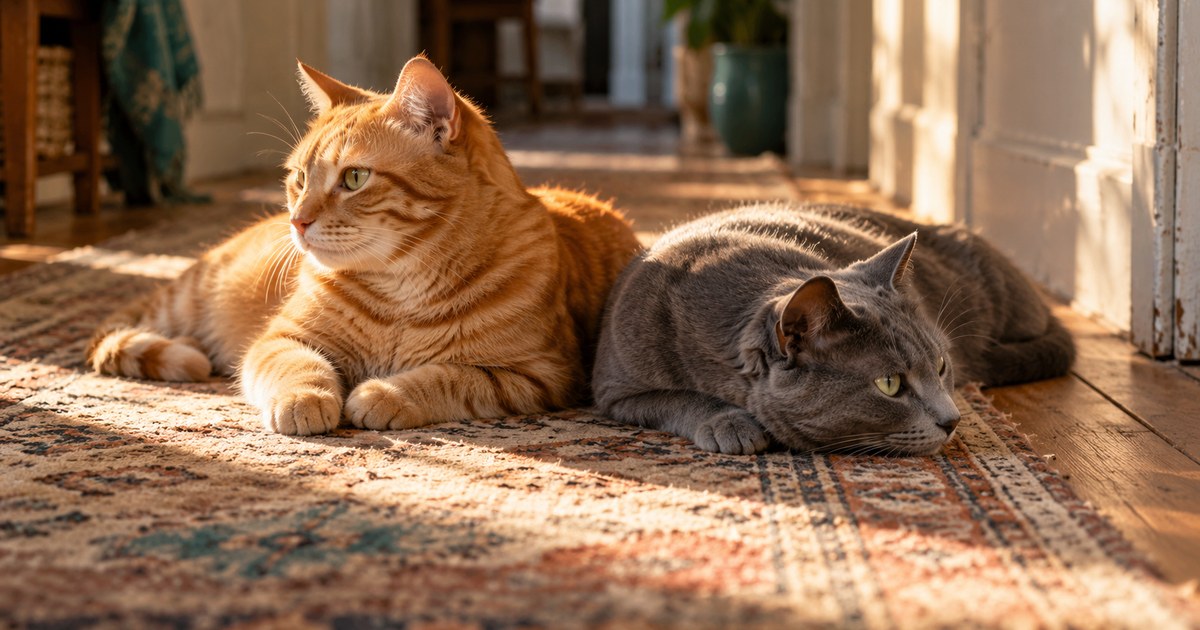
Cat colors look endlessly varied, but there are only two pigments underneath all of them: a black-brown one and a red-yellow one. Every coat you have ever seen is one or both of those, then switched on in bands or solid, lightened, blanked out with white, or pushed to the cooler extremities of the body.
Every cat color comes from two pigments, black-based and red-based. A small number of named genes then decide whether the cat is striped or solid, whether the color is full strength or diluted to gray and cream, and whether white patches or dark points appear. None of those colors is a breed.
What are the two pigments?
Geneticists call them eumelanin, the black-brown pigment, and pheomelanin, the red-yellow one. Toh and colleagues, writing in Current Biology in 2025, describe the orange gene as “shifting pigment synthesis from eumelanin to pheomelanin,” which is the cleanest way to see it: a cat’s base color is decided by which pigment its pigment cells make.
The names breeders use for the results are not the names most owners use, and that trips people up. The Cat Fanciers’ Association explains that “geneticists and breeders refer to a cat that is gray as a blue cat,” that “experts call an orange cat a red cat,” and that “a yellow or beige cat” is called cream. A solid brown cat may be called “sable, chocolate, chestnut or sepia,” and a lavender cat “lilac, lavender, platinum or frost, depending on the breed.” Black and white, CFA notes, are about the only colors everyone calls the same thing.
Gene by gene: how does one cat end up orange and another gray?
Take the genes in the order they matter for what you see.
1. Orange or not orange
The first switch is the orange gene, which is unusual because it sits on the X chromosome. Its identity stayed unknown until 2025, when Toh and colleagues reported that “a 5.1-kilobase (kb) deletion within an intron of the X-linked ARHGAP36 gene” is “closely and exclusively associated with orange coloration.” With it, the cat makes red-yellow pigment; without it, black-brown.
Because the gene is on the X chromosome, a female with one orange copy and one non-orange copy shows both, in patches. Toh’s paper describes those alternating patches in tortoiseshell and calico cats as classic examples of random X chromosome inactivation. That is the whole reason tortoiseshell and calico coats are overwhelmingly female, which the calico cat page and the orange cat genetics post work through in detail.
2. Striped or solid
The second switch decides whether the hairs carry bands of color, which is what makes tabby markings visible. Eizirik and colleagues, in Current Biology in 2003, found that “a 2 bp deletion in the ASIP gene specifies black coloration in domestic cats.” ASIP is the agouti gene. A cat with two copies of that deletion is solid black, because the banding that would reveal its tabby pattern is switched off.
CFA lists four tabby patterns that the banding can produce: mackerel, the narrow parallel stripes it calls “the most common”; classic, with “elaborate swirls on the sides and butterflies over the shoulders”; spotted; and ticked, where bands of color run along each hair with barring only on the legs and tail. The tabby cat page covers the four in full.
3. Full strength or diluted
The third switch is dilution, and it is the reason gray cats exist. Ishida and colleagues, in Genomics in 2006, traced it to “a single base pair deletion” in the melanophilin gene, MLPH. They write that dilution “affects both eumelanin and phaeomelanin pigment pathways; for example, black pigmentation combined with dilute appears gray and orange pigments appear cream.”
So a gray cat is, genetically, a diluted black cat, and a cream cat is a diluted orange one. The trait is recessive, which Ishida’s team describes as “fully penetrant, autosomal recessive.” A cat needs two copies to look gray. Two full-colored parents can therefore produce a gray kitten if both quietly carry one copy each. The same switch turns a tortoiseshell into a blue-cream and a calico into a dilute calico, which is the subject of the dilute calico and dilute tortie page.
4. White patches, or white all over
White is not a pigment at all. It is the absence of one, and it comes from a different gene. David and colleagues, in G3 in 2014, identified KIT as the feline White locus. A full-length retrovirus insertion in that gene was associated with white spotting, the patches that make a bi-color or a calico, and a shorter fragment of the same element was associated with all-over Dominant White. Their survey covered 270 cats from 30 breeds.
Whatever color sits underneath, white spotting simply prevents pigment from reaching some areas of the coat. A black and white cat is a black cat with spotting. A calico is a tortoiseshell with spotting.
5. Points, smoke and silver
Two more effects are worth knowing because they change the overall look so much.
The pointed pattern restricts color to the face, ears, feet and tail. CFA notes that “genetically, the Siamese gene is responsible for this pattern,” and adds the useful caution that “not every cat with the pointed pattern is a Siamese cat,” since the pattern “has been introduced into several hybrid and non-hybrid breeds and also into the at-large gene pool.”
Silver effects leave the hair white at the root with color only toward the tip. CFA describes cats whose hair “is white (silver) at the roots,” calling those with “the heaviest amount of pigmentation” smokes and those with the least chinchillas, with shaded cats in between.
Does a cat’s color tell you its breed?
Almost never. CFA is unambiguous: coat colors and patterns “do not suggest the breed (if any) of the kitten or cat.” Its example is that one may have “a Tortoiseshell Persian or Cornish Rex or a Tabby Oriental or Maine Coon Cat.” The genetics explain why. The dilute variant Ishida’s team found turned up in cats from 26 breeds and in random-bred cats, and the white spotting variant David’s team studied appeared across a 30-breed survey. These are shared parts of the cat genome, not breed property.
Color matters for breed only in the opposite direction. Some breeds permit just one color, so a color can rule a breed out. It can rarely rule one in.
What can a photo actually read in a cat’s color?
Quite a lot, as long as you know what you are looking at.
- Dilute or full strength. Gray against black, cream against orange. Judge it in daylight rather than under warm lamps.
- Tabby pattern. Mackerel, classic, spotted and ticked are all visible in a clear side shot.
- White spotting. The amount and placement of white is obvious in a photo and tells you the coat is a bi-color, van or calico.
- Points. A pale body with darker face, ears, feet and tail is easy to see.
- Smoke. A pale undercoat under dark tips shows only when the fur moves or is parted, so it needs a close-up rather than a portrait.
What a photo cannot read is anything hidden. A gray kitten’s parents may both look black, and nothing in their fur shows the recessive dilute copy they each carry. Genes that do not change the coat leave no trace on it.
Cat Identifier reads the visible part, color, pattern, white and points, along with the head and build that actually separate breeds, and returns the breeds your cat most resembles as a percentage mix. It describes visible likeness, not ancestry or genes. To put the color in context with the rest of your cat, start with what breed is my cat.
Sources
- Coat and Color Descriptions, The Cat Fanciers' Association
- Eizirik et al., Molecular genetics and evolution of melanism in the cat family, Current Biology 13(5), 2003
- Toh et al., A deletion at the X-linked ARHGAP36 gene locus is associated with the orange coloration of tortoiseshell and calico cats, Current Biology 35(12), 2025
- Ishida et al., A homozygous single-base deletion in MLPH causes the dilute coat color phenotype in the domestic cat, Genomics 88(6), 2006
- David et al., Endogenous retrovirus insertion in the KIT oncogene determines white and white spotting in domestic cats, G3 4(10), 2014