
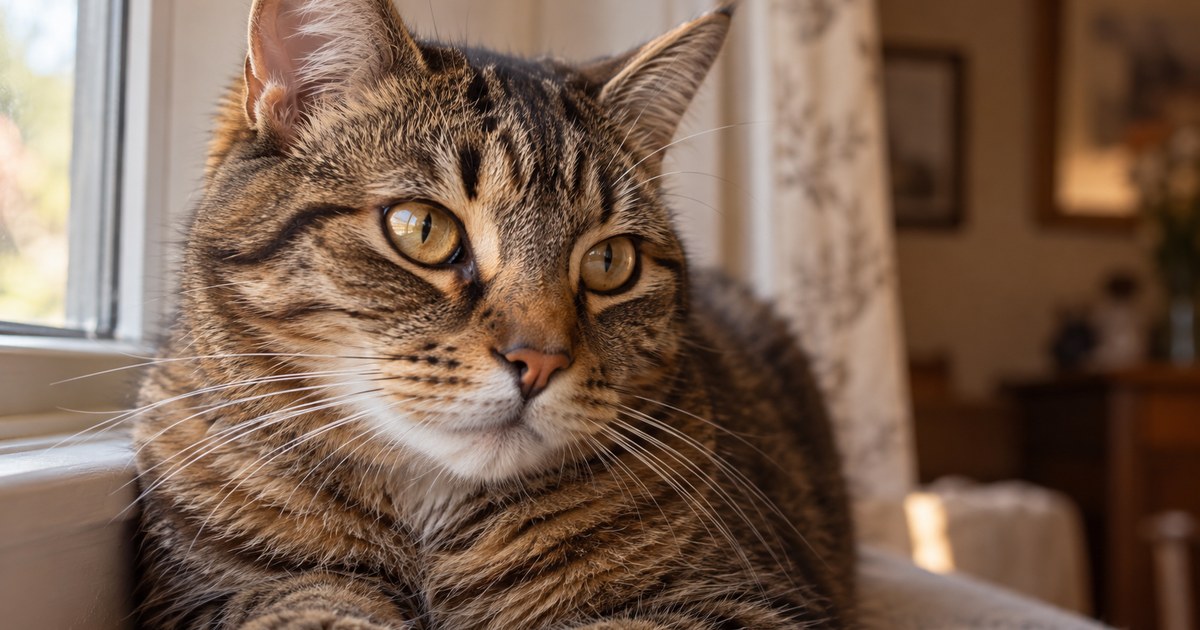
The Cat Fanciers’ Association names seven main eye colors in cats and says the pupil is always black. It also says eye color is genetically controlled in only two lines of breeding, the Burmese and the Siamese. Everywhere else the coat and eye link is selective breeding, so eye color narrows a breed rarely.
That is a much smaller claim than the articles promising to decode your cat from its eyes, and it comes from the registry rather than from a chart with nobody’s name on it.
What eye colors do cats actually come in?
CFA’s color guide gives the list directly: “The main colors of the eyes of cats are orange, copper, yellow, hazel, green, blue-green and blue. The pupil is always black.”
Seven names, and they describe a continuum rather than seven boxes. Hazel sits between green and gold, blue-green sits between green and blue, and copper is the deep end of orange. Two people can look at the same cat in the same room and reasonably call its eyes gold or copper, which is worth knowing before you try to match an eye against a breed requirement from memory.
The registry itself treats the category loosely. CFA’s guide to determining a cat’s color notes that eye color “is not recorded on CFA registration records except in the case of white cats.” For every other cat, the color of the eyes is not part of the permanent record at all.
Is eye color linked to coat color?
Sometimes, and the reason it is linked matters more than the fact that it is.
CFA puts it plainly: “Eye color can be linked and influenced by the color of the cat’s coat but that is not always the case. Most eye color that occurs with a specific coat color does so because of years and years of ‘selective breeding.’”
In other words, when a particular breed reliably shows a particular eye color, that is usually because breeders selected for the pair, not because one causes the other. A copper-eyed black cat in a show hall is the product of decades of choices. A copper-eyed black cat on your sofa is not evidence of those choices, and the same goes for the green-eyed tabby and the gold-eyed tuxedo.
There is one real exception, and CFA names it: “Only in those breeds influenced by the Burmese or Siamese gene is the eye color genetically controlled, yellow by the Burmese gene and blue by the Siamese gene.” Lyons and colleagues identified both variants in Animal Genetics in 2005, analyzing over 200 cats across twelve breeds and randomly bred cats. The Siamese pattern comes from an exon 2 change in the tyrosinase gene, a glycine to arginine substitution at position 302, and the Burmese pattern from an exon 1 change, glycine to tryptophan at position 227. Every pointed cat in their sample carried two copies of the Siamese variant. The lynx point Siamese page covers what that pattern looks like across its variations.
What makes a cat’s eyes blue?
Three genetic routes have been mapped, and all three run through pigment genes.
Dominant white is the first, through the KIT gene: David and colleagues reported in G3 in 2014 that cats homozygous for dominant white had odds of blue eyes 77.25 times larger than other genotypes.
The pointed pattern is the second, through the tyrosinase variant above, which is why a pointed cat’s eyes are blue rather than the color its coat would otherwise suggest.
The third is newer, and it breaks the rule everyone assumes. Abitbol and colleagues described dominant blue eyes in Animals in 2024, an autosomal dominant trait traced to the PAX3 gene in which blue eyes arrive with only minimal white spotting rather than a white coat. So a blue-eyed cat need not be white and need not be pointed.
The fuller version of all three, with the figures behind them, is in white cat with blue eyes.
What is an odd-eyed cat?
CFA gives both the phenomenon and the word: “White or predominantly white cats can have blue eyes, gold or copper eyes or one eye of each color, a copper eye and a blue eye. When a cat has two, different colored eyes, we term him or her an ‘odd-eyed’ cat.”
The clinical word for two differently colored irises is heterochromia, and odd-eyed is what CFA calls it. Two things follow from that sentence. The first is that odd eyes belong to the white genes rather than to any breed, which is consistent with the KIT result above: whatever makes one iris blue in a white cat can act on one eye and not the other. The second is that a white cat is not obliged to have blue eyes at all. Gold, copper and one of each are all ordinary outcomes, and none of them says anything about ancestry.
When do a kitten’s eyes change color?
CFA answers this the way an honest source does: “Kittens are born with blue eyes. It may take some time for the adult eye color to develop.”
That is the whole of what the registry commits to, and it is why CFA advises holding off on individually registering a white cat until you are sure of its eye color, while noting that a litter can be registered even though the adult eye color is not yet known. A cat body that has not finished deciding is not a cat you can classify.
The week-by-week timelines that circulate online, giving exact ages at which the change starts and finishes, are not in the registry material and we found no veterinary or peer-reviewed source behind them. Photograph the kitten, enjoy the kitten, and check the eyes again when the cat is grown.
Where does eye color actually narrow a breed?
In a short list of breeds where a standard makes a specific color mandatory, and CFA names them: “Egyptian Maus must have green eyes (specifically ‘gooseberry green’), as must Havana Browns and Oriental Shorthairs.” Mink patterned Tonkinese are required to have aqua eyes.
On those cats, eye color is genuinely diagnostic, and the wrong color takes the breed off the table no matter how well everything else matches. On every other cat it is a confirming detail at best, which CFA says outright in its guide to determining color: eye color “should not be used as the only determining factor,” and a cat can have an eye color other than the one specified and still be the coat color defined in the show rules.
Use it the way the registry does. Let coat, build, head shape and ear set point somewhere first, then check whether the eyes agree.
The numbers this post is not going to give you
A set of population percentages circulates across every article on this subject: roughly half of cats with yellow or orange eyes, ten to fifteen percent green, a few percent blue, odd eyes in under one percent. They appear with no methodology and no citation, phrased almost identically from site to site.
We went looking for the study behind them. It is not in the CFA material, and it is not in any of the three genetics papers above. Every trail ended at another article quoting a similar article, and CFA’s own position, that eye color is not even recorded for most registered cats, makes a precise national frequency table hard to imagine. So this post does not quote them. What it does quote is a measured odds ratio from a genotyped sample, 77.25, which is worth more than four tidy percentages with nobody’s name on them.
What eye color cannot tell you
It is not a breed. No registry lists an eye color as a breed, any more than it lists calico, tabby or tuxedo. The overwhelming majority of cats with striking eyes are unregistered domestic shorthairs and longhairs, because that is what most cats are.
It is not a personality. A registry standard describes what is typical of a breed, never what an individual cat will be like, and nothing we could find published connects iris color to behavior.
It is not a health reading. There is one genuine association in this area, between white coats, blue eyes and hearing, and its sourced figures are in the post linked above. Anything about your own cat is a conversation for your veterinarian.
What eye color does do is finish an identification that structure started. Photograph the cat in daylight without flash, which shifts iris color badly, and get the whole face in frame at the cat’s own eye level. Cat Identifier reads head shape, coat, build and eyes together and returns the breeds your cat most resembles as a percentage mix, with the traits behind each match. It is a statement of visible likeness rather than ancestry, and only registration papers from a registry establish pedigree. To work through the features in order yourself, what breed is my cat takes them one at a time.
Sources
- Coat and Color Descriptions, The Cat Fanciers' Association
- Hints for Determining A Cat's Color, The Cat Fanciers' Association
- David et al., Endogenous retrovirus insertion in the KIT oncogene determines white and white spotting in domestic cats, G3 4(10), 2014
- Lyons et al., Tyrosinase mutations associated with Siamese and Burmese patterns in the domestic cat, Animal Genetics 36(2), 2005
- Abitbol et al., Different Founding Effects Underlie Dominant Blue Eyes (DBE) in the Domestic Cat, Animals 14(13), 2024