No. Orange is carried on the X chromosome, and a male needs only one copy to be orange while a female needs two. That makes orange males more common than orange females. It does not make a female orange cat rare in the way a male calico is, and no registry or veterinary source publishes a firm ratio.
That last part matters, because the internet is full of a number that nobody can source. Here is what the genetics actually says, and what the one large published survey actually measured.
Why is orange carried on the X chromosome?
Because of where the mutation landed. The Governing Council of the Cat Fancy states it directly in its breeding policy genetics notes: orange is a mutation on the X chromosome and is therefore sex-linked. The gene eliminates all melanin pigment, meaning black and brown, from the hair fibers, and replaces it with a lighter compound that appears yellow or orange depending on how densely the pigment granules are packed.
That is why orange behaves differently from almost every other coat color. Black, chocolate, dilute and white spotting all sit on ordinary chromosomes and are inherited the same way in both sexes. Orange does not. Orange rides on the chromosome that also decides sex, and the two get tangled together for the rest of the cat’s life.
GCCF adds one more useful line for anyone looking at their own cat: rufus polygenes, which have not been identified, affect how rich the orange expression is. That is the honest explanation for why one ginger cat is a deep marmalade and the next is a pale sandy color, with no difference in the gene itself.
Why does a female need two copies and a male only one?
Count the chromosomes. A tom has one X and one Y. Whatever the single X says about orange is the final word, because there is no second X to contradict it. A queen has two X chromosomes, so she gets two votes.
Kaelin and colleagues put the requirement precisely in their 2025 Current Biology paper: the sex-linked orange mutation produces orange coat color in hemizygous males, meaning males carrying it on their one X, and in homozygous females, meaning females carrying it on both. One copy is enough for a male. A female needs the pair.
And a female with exactly one copy is not a half-orange cat. She is a tortoiseshell, or a calico if she also carries white spotting, because each of her cells switches off one X at random and the coat ends up patched. Kaelin’s team describe the orange patches as clones in which the non-orange copy was inactivated and the black or brown patches as clones in which the orange copy was inactivated. The full version of that story is in are calico cats always female, and the coats themselves are covered on the tortoiseshell cat and calico cat pages.
So there are three outcomes for a female and only two for a male. That asymmetry is the entire answer to the question.
What proportion of orange cats are male?
Nobody we would cite has published one.
This is worth being blunt about, because a figure of roughly 80 percent gets repeated across pet blogs, quiz pages and social posts as though it came from a study. We went looking for the study. It is not in the registry material, it is not in the veterinary references, and it is not in either of the 2025 papers that finally identified the orange gene. Every trail we followed ended at another blog quoting a blog.
What does exist is an allele frequency. Leaman, Rowland and Long surveyed 2,585 veterinary practices in the United Kingdom for the Veterinary Record in 1999 and collected coat color and sex for 9,816 cats. From that sample they calculated the frequency of the orange gene at 19.7 percent.
Read that carefully, because it is a statement about chromosomes rather than about cats. Fewer than one X chromosome in five in that population carried orange. A male needs one such chromosome and gets it from his mother. A female needs two, one from each parent. Those are not the same ask, and the gap between them is why orange toms are the ones people notice.
It is also one country in one year, gathered from practices that chose to reply, so it is a good number for what it measures and a poor foundation for a confident global percentage. A female orange cat is less likely than a male one. Putting a decimal point on how much less likely would mean inventing it.
Which gene is it, and what does it do?
Two teams answered this in 2025, working independently and publishing in the same journal.
Toh and colleagues reported that a deletion of 5.1 kilobases inside an intron of the X-linked ARHGAP36 gene is closely and exclusively associated with orange coloration. The deleted stretch contains a conserved element that looks like a regulatory switch, and removing it appears to change how much ARHGAP36 the cell makes. In cat skin, higher expression of that gene lines up with many pigment-making genes being turned down, which the authors suggest shifts production from the dark pigment eumelanin toward the reddish pigment pheomelanin. The same deletion turned up across orange cats generally, which points to the whole orange population descending from a single original mutation.
Kaelin and colleagues reached the same locus by a different route in the companion paper. Between them, a question that had been open since the early days of cat genetics closed in a single month.
Why does every orange cat have tabby markings?
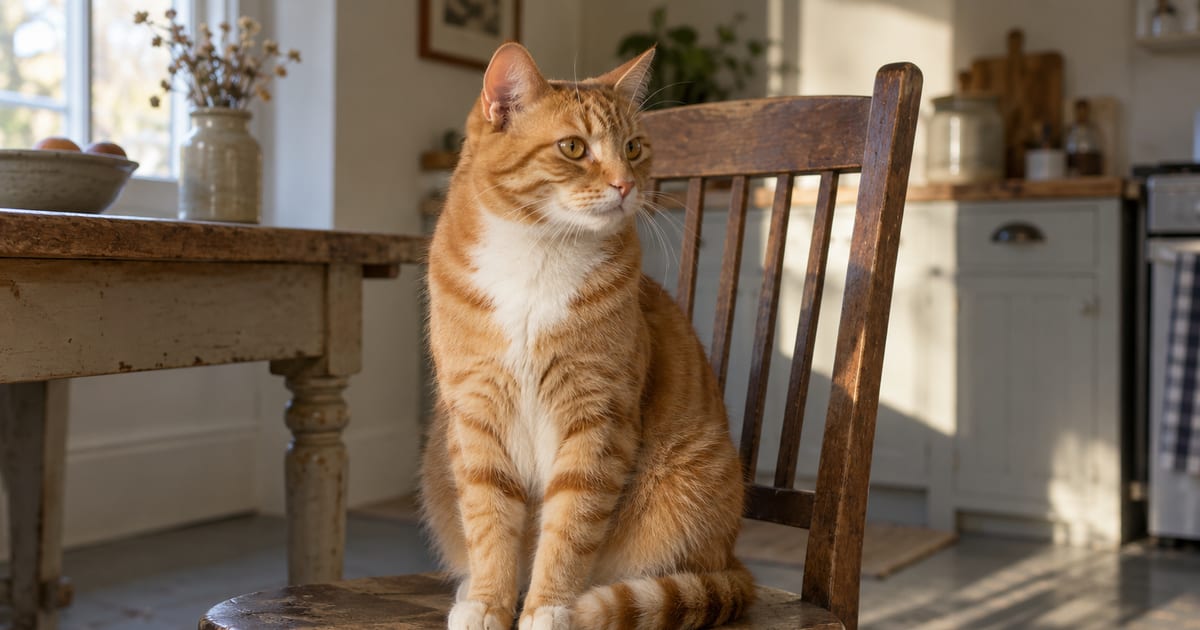
Because orange overrides the gene that would have removed them. GCCF explains the interaction: the orange allele is epistatic over the non-agouti genotype, so the mutation that normally produces a solid, unpatterned coat has no visible effect on a red or cream cat. That is why you can usually see some tabby pattern on red, cream and apricot cats even when they are genetically non-agouti, sometimes only on the head and face.
Which is to say there is no such thing as a solid orange cat in the way there is a solid black one. Look at the forehead, the legs and the tail of any ginger cat in good light and the stripes or blotches will be there. The orange tabby cat page covers the variants, and the tabby cat page covers the four pattern types those markings fall into.
The pale version has a name too. GCCF describes dilute as a recessive gene that spreads the pigment granules out along the hair shaft, turning black to blue and red to cream. A cream cat is an orange cat with the volume turned down.
Is orange tabby a breed?
No. The Cat Fanciers’ Association breed list contains no entry for orange tabby, ginger, marmalade or red, because all of those describe color rather than breed. Orange appears inside plenty of recognized breeds and inside an enormous number of cats that belong to no breed at all, which is the answer covered on the domestic shorthair page.
What a photo can tell you about an orange cat
It can read the things that actually separate breeds: coat length and texture, the tabby pattern under the color, body build, head and muzzle shape, ear set, eye shape and tail. Color is the least informative feature on that list (eye color is no better, as cat eye colors explained shows), which is exactly why “what breed is my orange cat” is a harder question than it sounds.
Cat Identifier reads one photo and returns the breeds the cat most resembles as a percentage mix, along with the traits, typical temperament and history behind each match. It is a read on visible likeness, not on ancestry, and only registration papers from a registry establish pedigree. To work the same sorting by hand, start with what breed is my cat.
Sources
- Toh et al., A deletion at the X-linked ARHGAP36 gene locus is associated with the orange coloration of tortoiseshell and calico cats, Current Biology 35(12), 2025
- Kaelin et al., Molecular and genetic characterization of sex-linked orange coat color in the domestic cat, Current Biology 35(12), 2025
- Recommended Breeding Policy for the Asian Group of Cats, The Governing Council of the Cat Fancy
- Leaman, Rowland and Long, Male tortoiseshell cats in the United Kingdom, Veterinary Record 144(1), 1999
- Breeds, The Cat Fanciers' Association