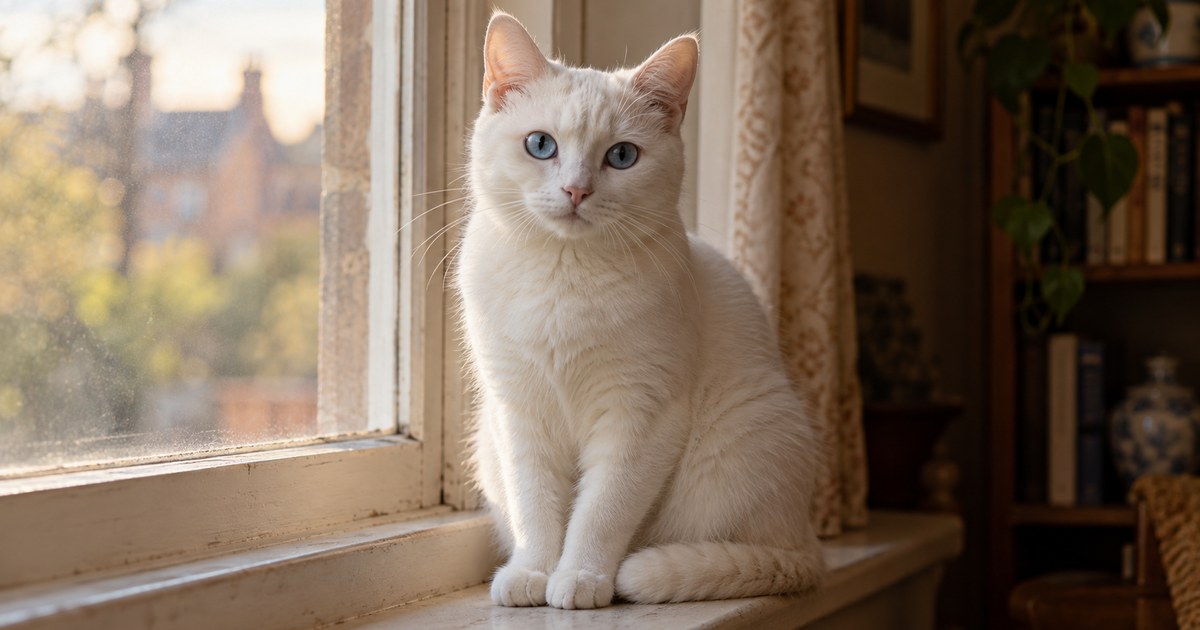
A white coat with blue eyes is a color combination, not a breed. At least three separate genes can produce blue eyes in a cat, and the one your cat carries changes what the eyes mean. Several registered breeds allow the combination, and an enormous number of unregistered cats carry it too.
So the eyes are worth reading carefully, because unlike coat color they occasionally do narrow things down. Just not in the way the breed listicles suggest.
Why is the cat white?
Because of a retrovirus that got into a pigment gene a long time ago.
David and colleagues reported in G3 in 2014 that white coloring in domestic cats comes from insertions of feline endogenous retrovirus 1 in intron 1 of the KIT gene. A long terminal repeat insertion produces dominant white, the fully white cat. A full length version of the same element, 7,125 base pairs, in the same location produces white spotting instead, the patches and bibs and socks, which is why a grey and white cat is best read from its white first. The authors describe an allelic series in which dominant white is dominant over white spotting, which is in turn dominant over the wild type.
The mechanism matters for identification. Dominant white does not make a cat’s pigment white. It stops pigment cells reaching the skin, so the cat underneath is still genetically whatever color it was. A dominant white cat can be a genetically black cat, a tabby or a tortoiseshell, wearing a coat that shows none of it. That is why a white cat gives a photograph almost nothing to work with, and why white is even less informative than solid black.
Why are the eyes blue?
Three different routes, and they are worth telling apart.
Route one: dominant white. The same KIT insertion that removes the coat pigment also affects the iris. David’s team measured the association directly: cats homozygous for dominant white had odds of blue irises 77.25 times larger than other genotypes, at P less than 0.0001. A fully white cat with blue eyes is very often this.
Route two: the pointed pattern. Lyons and colleagues identified the mutations behind it in Animal Genetics in 2005, analyzing over 200 cats across twelve breeds and randomly bred cats. The Siamese pattern comes from an exon 2 change in the tyrosinase gene, a glycine to arginine substitution at position 302, and every cat in the study with a pointed coat was homozygous for it. Pointed blue eyes come with a cream body and colored ears, mask, paws and tail, so the cat is not actually white even when it looks pale in low light. The lynx point Siamese page covers the versions of that pattern people mistake for one another.
Route three, the one nobody mentions: blue eyes with almost no white at all. Abitbol and colleagues described this in Animals in 2024 under the name dominant blue eyes. It is an autosomal dominant trait in which blue eyes travel with only minimal white spotting rather than a white coat, and it turned up in outbred cats from Kazakhstan and Russia, in British lineages, and in Dutch Maine Coons. The team traced it to the PAX3 gene, and in a panel of 117 blue-eyed cats found a retrovirus insertion in intron 4 of PAX3 fully associated with the trait in several lineages. Breeders have built new breeding lines around it under names like Altai, Topaz and Celestial.
Three routes, three different looks: an all-white cat with blue eyes, a pale cat with colored points and blue eyes, and a colored cat with blue eyes and barely any white. If your cat is the third kind, the breed lists on page one do not contain it.
Which registered breeds allow white with blue eyes?
Several, and the Turkish Angora is the clearest example because CFA’s standard is explicit about both halves.
On color, CFA accepts “WHITE: pure white, no other coloring,” and the breed profile notes that historically “only the white cats, which have always been the most popular, were considered authentic.” On eyes, acceptable colors include “blue, which encompasses shades from sky blue to sapphire,” alongside green and amber, and “odd-eyed, with one blue eye and the other green, green-gold or amber.”
That is a registry saying the combination is standard in the breed. What it does not say, anywhere, is that the combination identifies the breed. The rest of the Turkish Angora standard is where the identification actually lives: a head that is a “medium long, smooth wedge” with two flat planes, ears that are “large, wide at base, pointed and tuffed. Set closely together, high on the head, vertical and erect,” a body “medium size; finely boned with firm muscularity,” and a coat that CFA records as “single coated,” with body coat length varying but the tail and ruff “long, full, finely textured” with “a silk-like sheen.”
The single coat is the useful one. Most longhaired cats carry an undercoat. A white longhaired cat with a single coat, a wedge head and tall close-set ears has a real resemblance. A white cat with a dense double coat and a round head does not, whatever color its eyes are.
What about hearing?
This is a health topic, so here is only what the cited sources state, and then the sensible next step.
CFA’s Turkish Angora breed profile states that “white cats can be prone to deafness, especially blue-eyed cats.”
Strain’s 2015 review in Frontiers in Veterinary Science gives the measured figures, and they are a range rather than the single number that gets repeated online. Across three studies of non-purebred white cats, combined with a total of 256 cats, he reports deafness prevalence of “12.1% unilateral and 37.9% bilateral, or 50% affected.” Broken down by eye color, “combined deafness prevalence was 85% or 65% in cats with two blue eyes, 40% in cats with one blue eye, and 22% or 17% in cats with no blue eyes.” Three pure breeds come out lower in his table, 18 percent in Norwegian Forest Cats from a sample of 329, 17 percent in Maine Coons from 134 and 11 percent in Turkish Angoras from 474, but those samples included white and colored cats together and rested on behavioral testing, which Strain says makes the percentages “likely underestimates because behavioral testing would not have identified unilaterally deaf cats.” He also notes that a specific gene mutation responsible for deafness in white cats “has nevertheless not yet been confirmed.”
Two honest readings follow from that. The first is that the numbers vary a great deal between populations, eye colors and testing methods, which is why a single confident percentage repeated across pet websites should be treated with suspicion. The second is that these are prevalence figures for populations rather than a rule about any individual cat. If you have any question about your own cat’s hearing, that is a conversation for your veterinarian, who can test it properly. A photograph cannot tell you anything about it, and this site does not try to.
So what do the eyes narrow down?
Honestly, one thing well and everything else poorly.
They tell you which pigment route the cat is on. Blue eyes with a fully white coat point at dominant white. Blue eyes with a cream body and dark points point at the pointed pattern, which is standard in a short list of breeds. Blue eyes on an otherwise colored cat with a small white patch point at something else entirely, and that route is the newest of the three in the literature: Abitbol’s team added a third PAX3 variant to two the same group had described earlier, and reported that the underlying variant is still undetermined in some other blue-eyed lines.
What they do not tell you is the breed. The combination appears in registered Turkish Angoras, Persians, Orientals, Ragdolls and others, and in a very large number of cats with no registry record at all. A white blue-eyed cat found as a stray is, on the numbers, most likely a domestic shorthair or domestic longhair carrying the dominant white allele. That is the boring answer and usually the right one.
For the features that do narrow a white cat down, work from the outline in. Coat length and whether it is single or double, then body build, then head shape, then ear size and set. Cat Identifier reads those from one daylight photo and returns the breeds your cat most resembles as a percentage mix, which is a statement of visible likeness rather than ancestry, and only registration papers from a registry establish pedigree. Shoot against a darker background so the white coat keeps its edges, and try what breed is my cat if you would rather work through it yourself.
Sources
- David et al., Endogenous retrovirus insertion in the KIT oncogene determines white and white spotting in domestic cats, G3 4(10), 2014
- Strain, The Genetics of Deafness in Domestic Animals, Frontiers in Veterinary Science 2, 2015
- Lyons et al., Tyrosinase mutations associated with Siamese and Burmese patterns in the domestic cat, Animal Genetics 36(2), 2005
- Abitbol et al., Different Founding Effects Underlie Dominant Blue Eyes (DBE) in the Domestic Cat, Animals 14(13), 2024
- Turkish Angora breed profile and show standard, The Cat Fanciers' Association