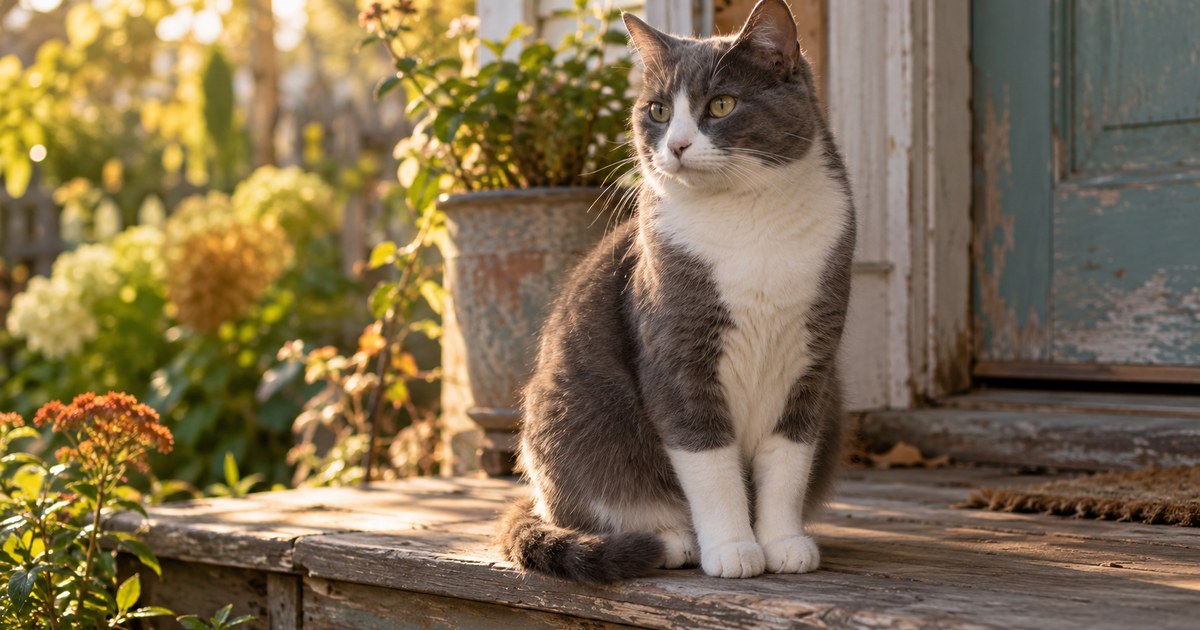
Look at the white before you look at the gray. A cat with white on its chest, paws or face has already ruled itself out of the best-known gray breed, because the Cat Fanciers’ Association disqualifies a Russian Blue for a single white locket or button. So when you ask what breed your grey and white cat is, the white is the first clue.
Grey and white is a coat description, not a breed. It means a gray coat, which breeders call blue, plus a separate white spotting gene that switches pigment off in patches. Unregistered domestic cats carry both all the time. A few breeds accept the combination, the British Shorthair most prominently, but the likeliest answer is a domestic cat.
What is a grey and white cat, genetically?
Two separate things are happening in one coat, and it helps to take them one at a time.
The gray. The Cat Fanciers’ Association notes that “geneticists and breeders refer to a cat that is gray as a blue cat.” In most gray cats, that blue is black pigment that has been diluted. Ishida and colleagues, writing in Genomics in 2006, traced the dilute effect to a single base deletion in a gene called melanophilin (MLPH). They describe the result plainly: “black pigmentation combined with dilute appears gray.” The trait is autosomal recessive, so a cat needs two copies, and they found the same variant in 97 unrelated dilute cats from 26 breeds and random-bred cats, consistent with one mutation event behind gray cats everywhere. That spread is the point. Gray belongs to no single breed.
There is a second kind of gray. CFA describes a silver tabby as “a silver-white background color with black tabby markings,” which reads as gray from across a room but is a different color genetically. If your cat’s gray is striped with near-black on a pale ground, it is a silver tabby and white rather than a blue and white. If the gray is soft and even, or striped in a darker gray on a cream-tinged ground, it is blue, solid or tabby.
The white. White patches come from a different gene altogether. David and colleagues, publishing in G3 in 2014, identified KIT as the feline White locus and found that a full-length retrovirus insertion in that gene is associated with white spotting, while a shorter fragment of the same element is associated with all-over Dominant White. Their survey covered 270 cats across 30 breeds. White spotting, in other words, is another shared piece of cat genetics rather than a breed signature.
Put the two together and you have what CFA calls a bi-color: “a parti-colored cat with solid areas of white and another color and/or pattern.” CFA lists blue and white among “the usual colors of the bi-colored cat” and notes that all of them “can occur in male and female cats.” A grey and white cat is a bi-color. That is the full name of its coat.
Why does the white rule out the Russian Blue?
Because the Russian Blue is a breed that comes in one color only, and that color has no white in it.
CFA’s Russian Blue standard asks for an “even bright blue throughout,” with guard hairs “distinctly silver-tipped giving the cat a silvery sheen,” and eyes of “vivid green.” Its disqualification list includes “Locket or button” and “Any color other than blue.” A locket is a white patch on the throat or chest. A cat with even a small white bib therefore cannot be a show-standard Russian Blue, no matter how plush its gray coat looks.
This matters because the Russian Blue is the breed almost everyone with a gray cat thinks of first. A gray and white cat can still share the Russian Blue’s coat color, since both are blue, but the white is the visible sign that something else is going on. If your cat is solid gray with no white at all, the Russian Blue versus gray cat page works through that question feature by feature.
Which breeds do come in grey and white?
Several breeds accept bi-colors, and the British Shorthair is the one most often meant when people picture a heavy, round-faced gray and white cat.
CFA’s British Shorthair standard lists “black and white, blue and white, red and white, cream and white, chocolate and white, lilac and white” among its bi-colors. Its preferred minimum for a bi-color is “some white on the feet, legs, undersides, chest and muzzle,” with less white than that penalized. Eye color for the bi-colors is “gold to copper or odd-eye.” Note the contrast with the breed’s solid blue, which must have “No tabby markings or white anywhere.” The British Shorthair allows white only when the cat is shown as a bi-color.
The coat is the next thing to check. CFA describes the British coat as “short, very dense, well bodied, firm to the touch, with a crisp, resilient texture,” and is specific that it is “Not double coated or woolly.” If the coat is pushed against the grain, “the coat will return toward its prior position.” That springback is something you can test on the sofa.
There is also a pattern within bi-color worth knowing. CFA calls a bi-color with more white than color a “bi-color van,” in which “the majority of the color is on the ears and the tail.” A mostly white cat with a gray cap and a gray tail is van patterned. That is again a pattern description, used across breeds, rather than a breed on its own.
What features other than color would point at a pedigree?
Color has done its job once it has ruled the Russian Blue out. The features that could point at a breed are the ones that make up a standard, and they are worth checking in this order.
- Head. CFA describes the British Shorthair head as “round and massive,” set on “a short thick neck,” with “round cheeks” and a profile showing “a gentle nose dip.” A narrower, longer head with no particular roundness is the head of most domestic cats.
- Eyes. The British standard asks for eyes that are “large, round, well opened” and “set wide apart and level.” Eye color in a bi-color British is gold to copper. Green eyes are not on that list, so a green-eyed gray and white cat sits outside the breed’s bi-color standard.
- Coat. Run your hand backward along the cat. A crisp, dense coat that springs back is closer to the British description. A soft, flat-lying coat is the ordinary domestic shorthair coat.
- Build. The British standard describes a body that is “medium to large, well knit and powerful,” with “a deep broad chest” and “short to medium strong legs.” A long, rangy body is penalized in that breed.
- Ears. The British Shorthair’s ears are “medium in size, broad at the base, rounded at the tips,” and “set far apart.” Tall, close-set ears are a domestic look.
A cat that passes all five is showing the British type. A cat that passes one or two is showing what most cats show, which is a mix of features from a shared gene pool.
So what breed is my grey and white cat, most likely?
Most likely none. CFA states the principle directly: coat colors and patterns “do not suggest the breed (if any) of the kitten or cat.” Both genes in a grey and white coat, dilute and white spotting, turn up across dozens of breeds and in random-bred cats, as the Ishida and David surveys show. A gray and white cat from a shelter, a neighbor’s litter or a barn is almost always a domestic shorthair or domestic longhair, which the domestic shorthair page explains properly. That is not a lesser answer, just the honest one.
The breed question only becomes interesting when the head, coat and build start lining up with a standard, and even then only registration papers that name a cat’s parents establish pedigree.
If you want a second opinion on the features, take one photo of the face straight on and one of the full body from the side, in daylight. Cat Identifier reads the head shape, coat and build in those photos and returns the breeds your cat most resembles as a percentage mix, which is a statement of visible likeness rather than ancestry. For the bigger picture of working out any cat’s type, start with what breed is my cat, and if your gray cat has a darker sibling, the black cat guide applies the same method to the other common solid color.
Sources
- Coat and Color Descriptions, The Cat Fanciers' Association
- British Shorthair breed profile and show standard, The Cat Fanciers' Association
- Russian Blue breed profile and show standard, The Cat Fanciers' Association
- Ishida et al., A homozygous single-base deletion in MLPH causes the dilute coat color phenotype in the domestic cat, Genomics 88(6), 2006
- David et al., Endogenous retrovirus insertion in the KIT oncogene determines white and white spotting in domestic cats, G3 4(10), 2014