Black is a color, not a breed, and it narrows the field less than almost any other coat. One recognized breed requires it. Dozens of others allow it. The overwhelming majority of black cats belong to no breed at all. What actually tells you something is the eye color, the coat texture and the outline of the head.
So the useful version of this question is not “which breed is black.” It is “what else is true about this particular cat,” and there are about five things worth checking.
Why is a black cat black?
Because of a deletion in a single gene. Eizirik and colleagues mapped, cloned and sequenced the cat versions of two candidate genes for melanism and reported in Current Biology in 2003 that a 2 base pair deletion in the ASIP gene, the agouti gene, specifies black coloration in domestic cats.
Agouti is the gene that bands each hair with light and dark. Switch it off and the banding disappears, the hair carries dark pigment along its whole length, and the cat reads as solid. That is why black sits opposite tabby rather than alongside it: every cat carries a tabby pattern, and a black cat is one whose pattern has been painted over.
The same paper puts domestic black in a wider frame. Melanistic coloration occurs as a common polymorphism in 11 of 37 cat species, and the authors found at least four independent genetic origins for it across the family, with different deletions responsible in jaguars and jaguarundis. Black is a thing cats have arrived at repeatedly, which is a good hint that it is not a breed signal.
Which breeds are actually black?
CFA’s own color guide defines the class plainly: cats with only one color and without a tabby pattern or white spots are called solid colored cats. Solid black sits inside that class, and it is available in a long list of breeds rather than owned by one.
Exactly one CFA breed is defined by it. The Bombay standard requires that the mature cat “should be black to the roots,” with a coat of “fine, short, satin-like texture; close-lying with a shimmering patent leather sheen.” CFA describes the breed as a hybrid created in the 1960s from the American Shorthair and the Burmese to produce a cat with the look and feel of a miniature panther. Everything else about a Bombay, from the rounded head to the medium build, is specified alongside the color, which is the point: the color alone was never the breed.
Elsewhere black is one option among hundreds. The Oriental is recognized in what CFA describes as “over 600 possible color, pattern, and coat length combinations,” and the registry does not even call the solid black version black in that breed. It is called ebony. Persians, Maine Coons, American Shorthairs, Devon Rexes and many others include solid black in their accepted colors while looking nothing like each other.
Which leaves the honest arithmetic. A black cat with no papers is far more likely to be an unregistered domestic shorthair or domestic longhair than any of the above, because that is what most cats are.
What do the eyes tell you?
More than the coat does, for this particular color.
CFA requires Bombay eye color “ranging from gold to copper, the greater the depth and brilliance the better,” and green eyes are a disqualification in the breed. That single line does a lot of work on a black cat. Deep copper eyes on a sleek black shorthair are at least consistent with the standard. Green eyes rule the Bombay out entirely, no matter how glossy the coat is.
The reverse is not true, and this is where black cats trip people up. Copper eyes do not make a cat a Bombay, because plenty of unregistered black cats have warm eyes. The Bombay cat versus black cat comparison walks the rest of the standard, including the nose leather and paw pads, which CFA requires to be black.
Is your black cat even black?
Worth checking before anything else, because black is the color most often reported wrong.
CFA’s guide to determining a cat’s color notes that black kittens “often develop rusty or coppery coats, white or silver hairs, or a lighter ruff and/or undercoat until full adult coat appears at 12-18 months.” A young cat that looks rusty in the sun may simply not have finished. That is a reason to photograph the cat again at eighteen months rather than a reason to conclude anything now.
Then part the coat and look at the roots. CFA describes smoke cats as having hair that is “white (silver) at the roots” with the cat’s primary color at the tip, and smokes are the ones carrying the heaviest pigmentation in that group. A cat that looks black standing still and flashes silver when it moves is a black smoke, not a solid. It is the same pigment, distributed differently, and it is a genuinely different color class on a show bench.
Finally, look in direct daylight for faint stripes across the flank or rings on the tail. Those ghost markings are the tabby pattern showing through, and they say the non-agouti coverage is imperfect rather than that the cat is a tabby.
What actually points at a pedigree?
In the order a photograph can check them:
Coat texture and length. Bombay short and patent-leather sleek, Persian long and dense, Devon Rex soft and wavy. Texture is visible in a single well-lit frame and separates more breeds than color does.
Body build. The Oriental is “long and svelte” with “a distinctive combination of fine bones and firm muscles.” The Bombay is “medium in size, muscular in development, neither compact nor rangy.” Those are opposite cats wearing the same color.
Head outline. Straight on, does the head read as a long tapering wedge, a rounded dome or a rectangle? The Oriental standard asks for a “long tapering wedge, in good proportion to body.” The Bombay asks for a head “pleasingly rounded with no sharp angles.”
Ear size and set. The Oriental’s are “strikingly large, pointed, wide at the base.” The Bombay’s are “medium in size and set well apart on a rounded skull.” On a black cat photographed against a dark background, the ears are often the only outline you can read.
Eye color and shape. Covered above, and the fastest single check on this color.
If those five land on the same breed, you have a reasonable resemblance. If they land in five different places, you have a cat, which is the usual and perfectly good answer.
Cat Identifier reads one daylight photo and returns the breeds your cat most resembles as a percentage mix, with the traits and typical temperament behind each match. On a black cat, shoot near a window without flash so the outline separates from the background, since a photo that is all silhouette has nothing for anyone to read. It is a statement of visible likeness rather than ancestry, and only registration papers from a registry establish pedigree.
The answer most black cats deserve
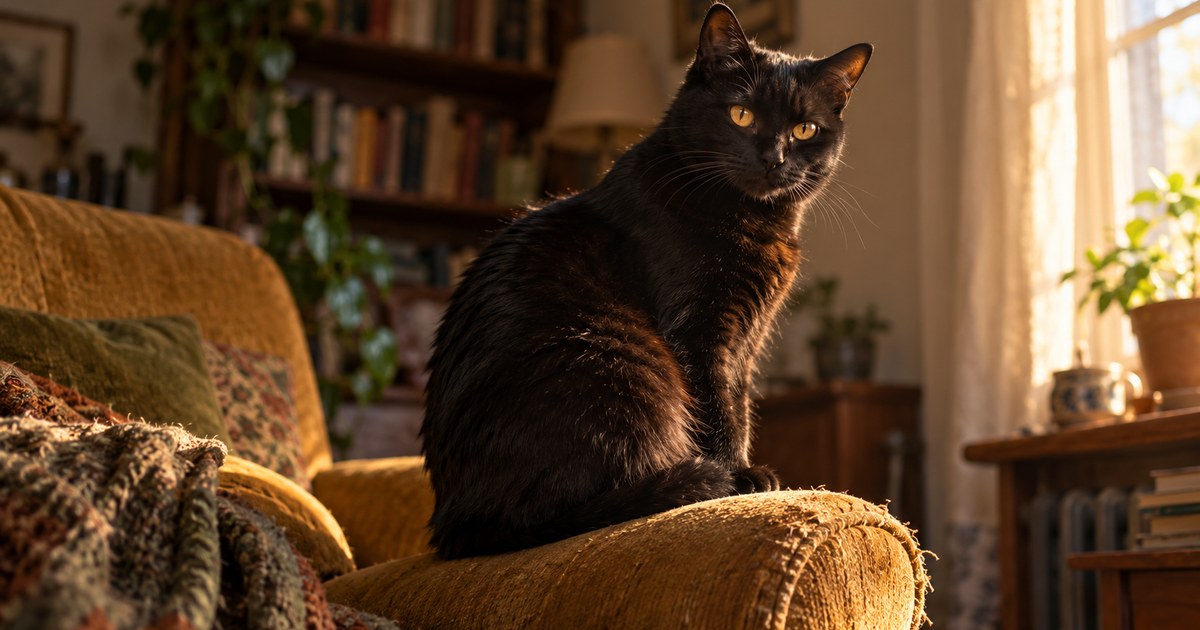
A solid black cat with gold eyes, a short glossy coat and no paperwork is not a Bombay that got lost. It is a black domestic shorthair, which is one of the most common cats in the world and one of the handsomest. Color is the single least informative feature on a cat, which is also true of calico and tortoiseshell, and it is why breed questions have to start somewhere else. To work through the rest of the features in order, what breed is my cat takes them one at a time.
Sources
- Eizirik et al., Molecular genetics and evolution of melanism in the cat family, Current Biology 13(5), 2003
- Bombay breed profile and show standard, The Cat Fanciers' Association
- Coat and Color Descriptions, The Cat Fanciers' Association
- Hints for Determining A Cat's Color, The Cat Fanciers' Association
- Oriental breed profile and show standard, The Cat Fanciers' Association